


Heart Leadership Index vs Hogan Assessments
Understanding Two Different Layers of Leadership Assessment
Leadership assessments are often compared as if they were competing tools. In reality, most assessments differ not in quality, but in the layer of leadership they are designed to measure.
This article explores the difference between Hogan Assessments, one of the most established personality-based leadership assessment systems, and the Heart Leadership Index (HLI), a framework designed to measure inner coherence as a foundation for leadership effectiveness.
This comparison is part of a broader leadership assessment landscape. For an overview of how different assessments relate to one another, see the full Leadership Assessment Comparison: From Personality to Inner Coherence.
Hogan and The Predictive Index are often shortlisted together. The Predictive Index behavioral assessment reads behavioral drives and fit to a role rather than personality traits and derailers, and it is compared to the HLI on its own page.
The Hogan Leadership Experience (HLX) is Hogan’s leadership development program, built on its Leadership Experience Assessment. It measures day-to-day leadership style and stress-based derailers, and Hogan offers it to organizations and to independent coaches. HLX works at the same personality layer described below, so the HLI pairs with it in the same way.
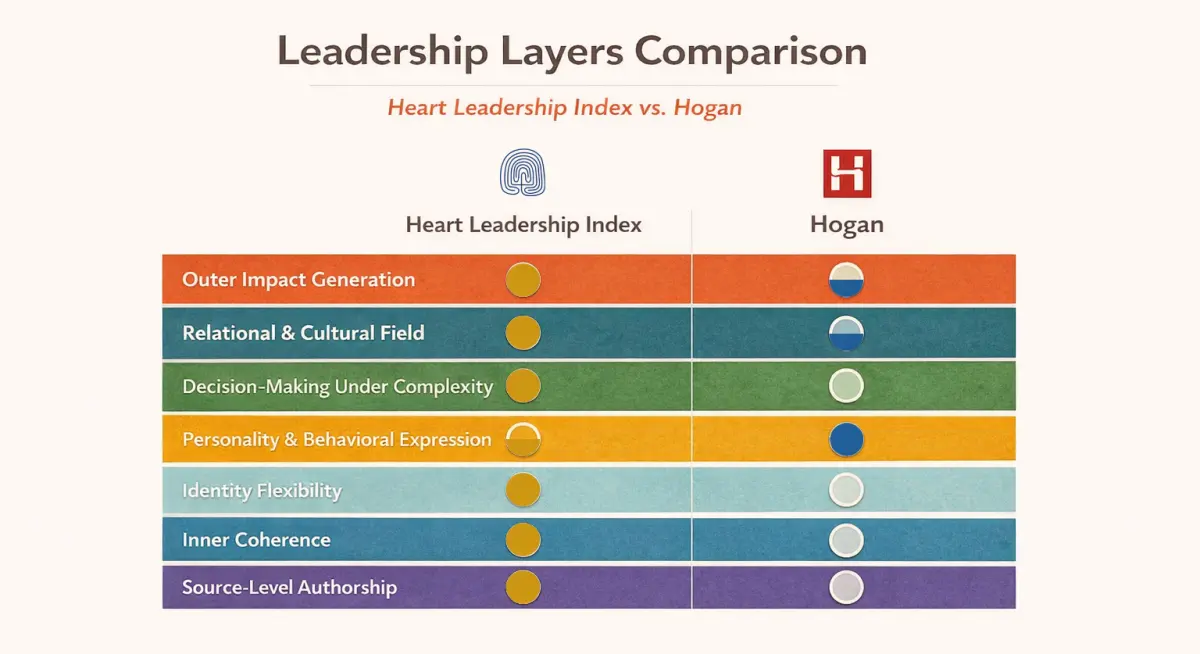
How to read the visual comparison
The visual above compares Hogan and HLI across seven leadership layers, from outer impact generation at the top to source-level authorship at the foundation.
Each circle indicates how directly an assessment operates at that layer:
-
● Primary focus
-
◐ Indirect influence
-
○ Not a core focus
The visual is not a scorecard. It shows where each tool is most useful.
Summary comparison table
The table below provides a concise reference for how Hogan Assessments and the Heart Leadership Index differ across key leadership dimensions.
| Dimension | Heart Leadership Index (HLI) | Hogan Assessments |
|---|---|---|
| Primary focus | Inner coherence and authorship | Personality traits, values, derailers |
| Leadership layer | Beneath identity and behavior | Identity and behavior |
| What is measured | State-based, developable coherence | Largely stable personality structures |
| Response to complexity | Direct and adaptive | Indirect and predictive |
| Orientation | Experiential and developmental | Predictive and descriptive |
| Time horizon | Longitudinal | Baseline profiling |
| Role in ecosystem | Foundational | Complementary |
Core focus: prediction versus coherence
Hogan Assessments are built on decades of psychological research in personality science. Their core objective is prediction: understanding how personality traits, motives, and derailers shape workplace behavior, leadership effectiveness, and risk under pressure. Hogan is widely used to help organizations make informed decisions about selection, succession, and leadership development.
The Heart Leadership Index starts from a different premise. It proposes that leadership effectiveness is rooted in inner coherence, defined as the alignment of awareness, emotion, intention, and action. Rather than predicting how a leader will behave, HLI assesses the internal conditions from which leadership behavior and decisions arise.
This distinction explains why Hogan excels at identifying patterns and risks, while HLI focuses on clarity, alignment, and developmental readiness.
What they measure
Hogan measures relatively stable aspects of personality:
- everyday behavioral tendencies
- leadership derailers that emerge under stress
- motives, values, and preferences that shape decision-making and culture
- optional 360-degree feedback and team analytics
These dimensions provide a robust picture of how a leader is likely to behave across contexts.
HLI measures seven dimensions of inner coherence:
- Presence
- Inner Peace
- Inner Joy
- Non-Attachment
- Selflessness
- Unity
- Purpose
Together, these dimensions describe how a leader relates to attention, emotion, identity, and connection. Rather than categorizing traits, HLI offers insight into where leadership is being authored from internally.
Underlying philosophy
Hogan’s framework is grounded in personality psychology. It assumes that personality structures are relatively stable and that understanding them allows organizations to anticipate leadership behavior, performance, and risk. Its strength lies in scientific validation, benchmarking, and consistency.
HLI is grounded in a coherence-based model of leadership. It views leadership quality as emerging from the leader’s inner state rather than from traits alone. From this perspective, changes in inner coherence naturally reorganize behavior, relationships, and outcomes, especially in complex or ambiguous environments.
These approaches are not contradictory. They operate at different depths of the human system.
Typical use cases
Hogan is commonly used in:
- talent acquisition and selection
- leadership development and succession planning
- executive coaching with certified interpretation
- culture and team diagnostics
It is particularly valuable where organizations want to reduce risk and make evidence-based people decisions.
HLI is typically used in contexts where leadership effectiveness depends on inner stability and clarity, such as:
- coherence building and leadership alignment
- mapping leadership coherence across teams
- board or investor assessment of human risk and stewardship readiness
- heart-centered leadership development programs such as the Heartful Method
HLI is especially relevant in environments characterized by complexity, uncertainty, and rapid change.
Output and interpretation
Hogan provides detailed personality reports that highlight strengths, risks, and values, often benchmarked against large normative datasets. Results are usually interpreted by certified professionals to ensure accuracy and ethical use.
HLI provides a coherence profile across internal dimensions, accompanied by insights linked to concrete practices leaders can adopt to strengthen coherence. At the team level, HLI highlights alignment patterns and leverage points rather than individual comparison.
The emphasis is on development over time, not diagnosis alone.
Who each assessment serves best
Hogan is well suited for organizations seeking:
- validated personality predictors
- structured comparison across leaders or candidates
- insight into leadership derailment risk
- strong alignment with traditional talent systems
HLI is most valuable for leaders and organizations ready to:
- move beyond identity-driven leadership
- cultivate inner clarity as a leadership capacity
- translate coherence into cultural and impact outcomes
- work upstream of behavior and performance
In simple terms
Hogan helps you understand how personality shapes leadership behavior and performance.
HLI helps you understand how inner coherence shapes clarity, trust, decision-making, and impact.
Many organizations choose to use both, each at the layer it serves best.
Sources and references
- Hogan Assessments official site:
https://www.hoganassessments.com - Hogan Leadership Forecast Series:
https://www.hoganassessments.com/products/leadership-forecast-series/ - Overview of Hogan Assessments and personality science:
https://positivepsychology.com/hogan-assessment/ - Heart Leadership Index (HLI):
https://hli.tapuat.com - Heart Leadership and coherence research:
https://tapuat.com/studies/