


Heart Leadership Index vs 360° Feedback
Perception-Based Feedback and Inner Coherence Compared
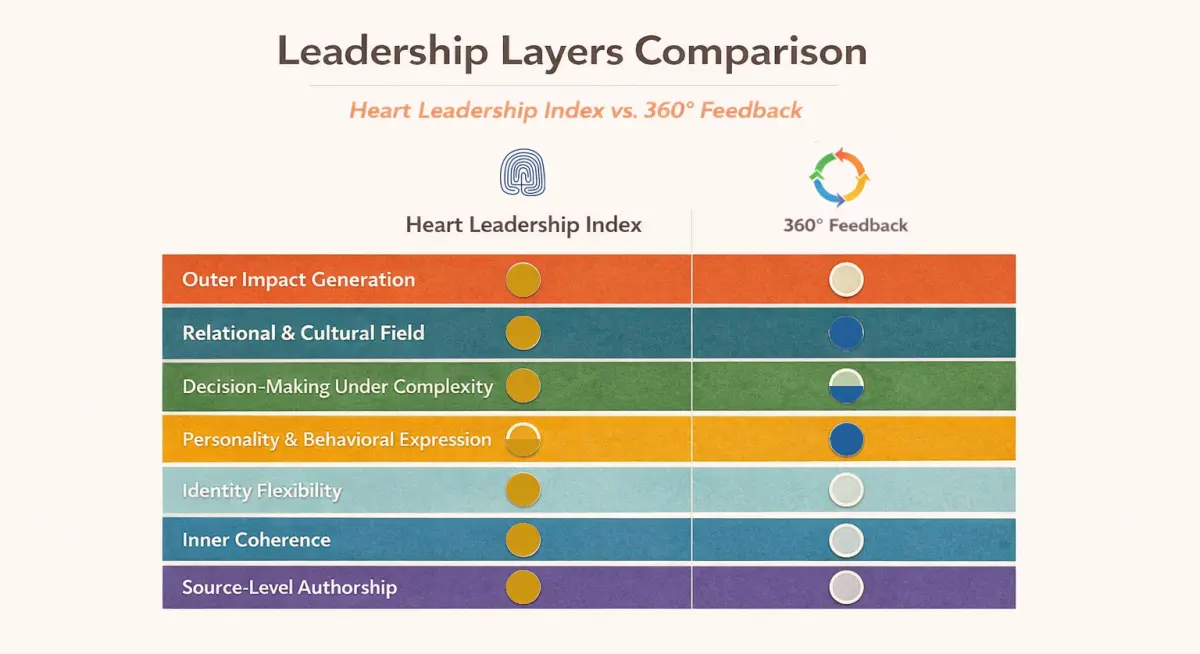
360° feedback is one of the most widely used leadership assessment approaches in organizations. By gathering feedback from peers, direct reports, managers, and sometimes external stakeholders, it offers leaders a multi-perspective view of how their leadership is experienced.
The Heart Leadership Index (HLI) approaches leadership assessment from a different starting point. Rather than measuring perception, it measures inner coherence as the source from which leadership behavior, decisions, and impact arise.
This article compares 360° feedback and HLI across leadership layers and clarifies when each is most useful. It is part of a broader framework mapping leadership assessments by depth and impact. For the full overview, see Leadership Assessment Comparison: From Personality to Inner Coherence.
How to read the visual comparison
The visual above compares 360° feedback and HLI across seven leadership layers, from outer impact generation at the top to source-level authorship at the foundation.
Each circle represents how directly an assessment addresses that layer:
- ● Primary focus
- ◐ Indirect influence
- ○ Not a core focus
The visual does not indicate superiority. It clarifies what each tool is designed to reveal.
Summary comparison table
| Dimension | Heart Leadership Index (HLI) | 360° Feedback |
|---|---|---|
| Primary focus | Inner coherence and authorship | Perceived leadership behavior |
| Leadership layer | Beneath identity and behavior | Behavior and relationships |
| What is measured | State-based, developable coherence | External perception |
| Response to complexity | Direct and adaptive | Indirect |
| Orientation | Developmental | Reflective |
| Time horizon | Longitudinal | Context-specific |
| Role in ecosystem | Foundational | Complementary |
Core focus: perception versus source
360° feedback focuses on how leadership is experienced by others. Its value lies in surfacing blind spots, relational patterns, and discrepancies between intent and impact. It reflects the social and cultural field surrounding a leader.
HLI focuses on where leadership is sourced from internally. Rather than reflecting perception, it assesses the inner conditions that shape perception, behavior, and decision-making in the first place.
This distinction explains why 360° feedback is often used to support awareness and accountability, while HLI is used to support clarity, stability, and coherence.
What they measure
360° feedback measures:
- observable leadership behaviors
- relational impact
- communication and collaboration patterns
- alignment with role expectations
It captures leadership through the lens of others’ experience in a specific context.
HLI measures seven dimensions of inner coherence:
- Presence
- Inner Peace
- Inner Joy
- Non-Attachment
- Selflessness
- Unity
- Purpose
These dimensions describe how a leader relates to attention, emotion, identity, and connection, offering insight into the internal conditions that shape leadership expression over time.
Underlying philosophy
360° feedback is grounded in the belief that awareness of perception enables growth. By seeing how leadership is experienced, leaders can adjust behavior, repair trust, and improve relationships.
HLI is grounded in a coherence-based philosophy. It assumes that sustainable leadership effectiveness arises when inner coherence increases, allowing behavior and relationships to reorganize naturally rather than through constant correction.
These approaches answer different leadership questions rather than competing.
Typical use cases
360° feedback is commonly used for:
- leadership development programs
- performance and growth conversations
- surfacing blind spots
- team and cultural diagnostics
It is especially effective when leaders are ready to receive and integrate external feedback.
HLI is typically used for:
- leadership clarity and coherence development
- navigating complexity and uncertainty
- aligning leadership teams at a deeper level
- supporting cultural and impact-driven transformation
HLI becomes particularly relevant when leadership challenges persist despite feedback and skill development.
Output and interpretation
360° feedback produces reports summarizing strengths, gaps, and perception patterns across rater groups. Interpretation often focuses on sense-making and action planning.
HLI produces a coherence profile across internal dimensions, along with insights tied to reflective and embodied practices. At the collective level, it reveals alignment patterns that influence trust, decision-making, and impact.
The emphasis is on inner development over time, not perception alone.
Who each assessment serves best
360° feedback serves leaders and organizations seeking:
- multi-perspective insight
- improved relational awareness
- accountability and reflection
- culture-sensitive feedback
HLI serves leaders and organizations ready to:
- work upstream of perception
- cultivate inner clarity and stability
- address leadership challenges at the source
- align inner coherence with cultural and impact outcomes
In simple terms
360° feedback shows leaders how they are experienced by others.
HLI shows leaders how their inner coherence shapes experience, decisions, and impact.
Used together, they can offer both reflection and foundation.
Frequently asked questions
What is the difference between 360-degree feedback and the Heart Leadership Index?
360-degree feedback measures how a leader’s behavior is perceived by peers, reports, and managers. The Heart Leadership Index measures inner coherence, the state beneath behavior from which decisions and impact arise. One reads external perception; the other reads the internal source that shapes it.
Can 360-degree feedback and the HLI be used together?
Yes. They answer different questions. 360 feedback surfaces blind spots and relational patterns in a specific context, while the HLI reveals the inner coherence that shapes those patterns over time. Used together, they pair reflection with foundation.
When should a leader use the HLI instead of 360-degree feedback?
The HLI is most useful when leadership challenges persist despite feedback and skill development, or when a leader is navigating identity-level change and complexity. It works upstream of perception, where 360 feedback cannot reach.
Does 360-degree feedback measure inner coherence?
No. 360 feedback captures observable behavior and relational impact through the experience of others. The inner conditions that shape leadership expression, such as presence, non-attachment, and purpose, are what the HLI reads through structured self-report.
Related comparisons
See how the HLI compares with other leadership assessments: HLI vs DISC, HLI vs MBTI, or the full leadership assessment comparison overview.
Measure your own leadership coherence with the HLI.
Sources and references
- Overview of 360-degree feedback:
https://www.mindtools.com/a2mi7nr/360-degree-feedback - 360 feedback in leadership development:
https://hbr.org/2019/03/the-feedback-fallacy - Heart Leadership Index (HLI):
https://tapuat.com/defrag - Heart Leadership and coherence research:
https://tapuat.com/studies/