


Heart Leadership Index vs MBTI
Cognitive Preferences and Inner Coherence Compared
The Myers-Briggs Type Indicator (MBTI) is one of the most recognized leadership and personality frameworks in the world. For decades, it has helped individuals and teams understand differences in perception, decision-making, and communication styles.
The Heart Leadership Index (HLI) approaches leadership assessment from a fundamentally different angle. Rather than describing cognitive preferences, it measures inner coherence as the foundation from which leadership clarity, decisions, and impact emerge.
This article explores how MBTI and HLI operate at different layers of leadership and how they can be understood as complementary rather than competing tools. It is part of a broader comparison of leadership assessments across depth and impact. For a complete overview, see Leadership Assessment Comparison: From Personality to Inner Coherence.
How to read the visual comparison
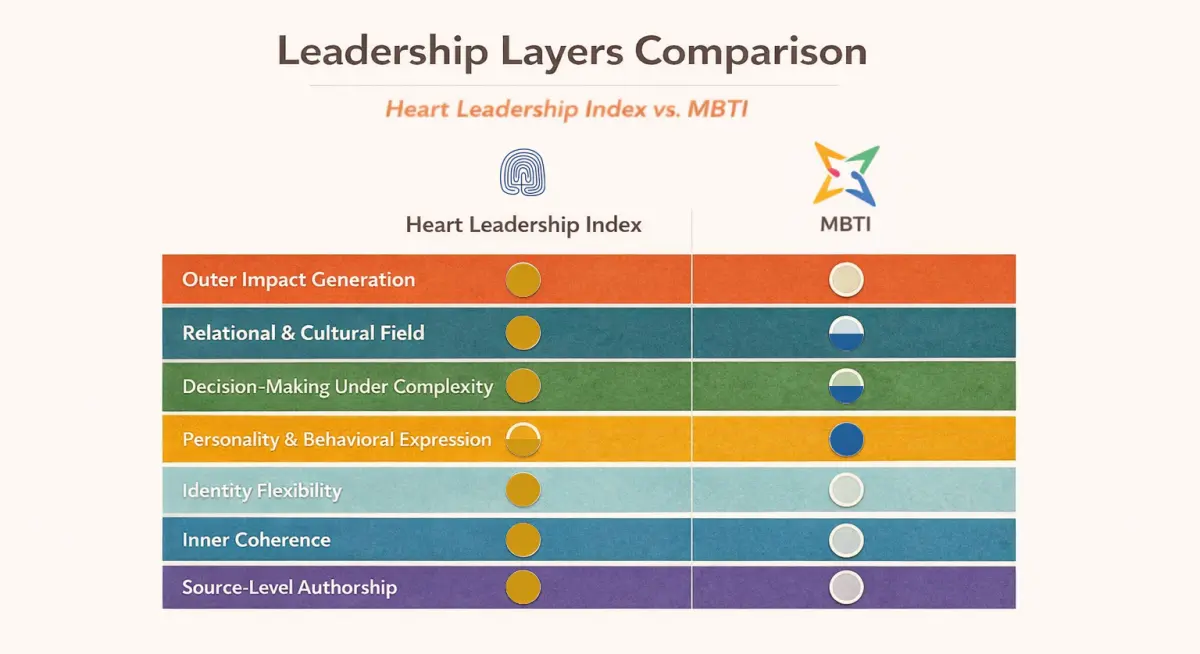
The visual above compares MBTI and HLI across seven leadership layers, from outer impact generation at the top to source-level authorship at the foundation.
Each circle represents how directly an assessment addresses that layer:
- ● Primary focus
- ◐ Indirect influence
- ○ Not a core focus
The visual is not a value judgment. It clarifies where each assessment is designed to operate.
Summary comparison table
The table below summarizes the primary differences between MBTI and the Heart Leadership Index.
| Dimension | Heart Leadership Index (HLI) | MBTI |
|---|---|---|
| Primary focus | Inner coherence and authorship | Cognitive preferences |
| Leadership layer | Beneath identity and behavior | Personality and cognition |
| What is measured | State-based, developable coherence | Stable preference patterns |
| Response to complexity | Direct and adaptive | Indirect |
| Orientation | Experiential and developmental | Descriptive |
| Time horizon | Longitudinal | Static typology |
| Role in ecosystem | Foundational | Complementary |
Core focus: how leaders think versus how leadership is sourced
MBTI focuses on how individuals perceive information and make decisions. By distinguishing preferences such as introversion and extraversion, sensing and intuition, thinking and feeling, MBTI offers language for understanding cognitive differences.
HLI begins upstream of cognition. Its core focus is inner coherence, the alignment of awareness, emotion, intention, and action. From this perspective, thinking styles are expressions of a deeper internal condition rather than the primary driver of leadership effectiveness.
This difference explains why MBTI is often used to improve understanding and communication, while HLI is used to explore clarity, presence, and leadership stability.
What they measure
MBTI measures preferences, not abilities. It describes how people tend to:
- take in information
- process experience
- approach decisions
- orient attention
These insights are useful for self-awareness and interpersonal understanding, particularly in team settings.
HLI measures seven dimensions of inner coherence:
- Presence
- Inner Peace
- Inner Joy
- Non-Attachment
- Selflessness
- Unity
- Purpose
Rather than categorizing how leaders think, HLI reveals how leaders relate to identity, emotion, and connection, offering insight into the conditions that shape thinking and behavior across contexts.
Underlying philosophy
MBTI is grounded in typological psychology. It assumes that people have enduring preferences that shape perception and decision-making. The framework is descriptive rather than predictive and is designed to support understanding rather than evaluation.
HLI is grounded in a coherence-based model of leadership. It assumes leadership quality emerges from the leader’s inner state, not from typology. From this view, sustainable leadership effectiveness arises when coherence increases, allowing thinking, behavior, and decisions to reorganize naturally.
These approaches address different questions rather than competing for the same answer.
Typical use cases
MBTI is commonly used for:
- self-awareness and personal development
- team communication and collaboration
- leadership workshops and offsites
- coaching conversations about cognitive style
It is especially effective when the goal is mutual understanding rather than evaluation.
HLI is typically used in contexts such as:
- leadership clarity and coherence development
- navigating complexity and uncertainty
- mapping alignment across leadership teams
- supporting culture and impact-driven transformation
HLI becomes most relevant when leadership challenges are no longer resolved by understanding preferences alone.
Output and interpretation
MBTI produces a type profile that describes cognitive preferences. Results are often self-interpreted or facilitated in group contexts and are designed to normalize difference rather than assess performance.
HLI produces a coherence profile across internal dimensions, accompanied by insights linked to reflective and embodied practices. At the team level, it highlights coherence patterns that influence trust, decision-making, and collective effectiveness.
The emphasis is on inner development over time, not classification.
Who each assessment serves best
MBTI is well suited for individuals and teams seeking:
- language for cognitive diversity
- improved communication and understanding
- non-evaluative self-awareness tools
- accessible personal development frameworks
HLI is best suited for leaders and organizations ready to:
- explore leadership beneath cognition and identity
- cultivate inner clarity and presence
- address leadership effectiveness at the source
- align inner coherence with cultural and impact outcomes
In simple terms
MBTI helps people understand how they think and process information.
HLI helps leaders understand how inner coherence shapes thinking, decisions, and impact.
Many organizations use MBTI to build understanding and HLI to work at the foundation that sustains leadership effectiveness.
Take the Heart Leadership Index — it is free and takes about seven minutes.
Frequently asked questions
What does the MBTI measure for leaders?
MBTI describes cognitive preferences: how a leader takes in information, makes decisions, and orients attention, across dimensions like introversion and extraversion or thinking and feeling. It maps stable preference patterns, not the inner state beneath them.
Is MBTI a good leadership personality assessment?
MBTI is useful for self-awareness and communication, and it is descriptive rather than evaluative or predictive. For leadership it maps thinking style but not the inner coherence from which decisions and behavior arise, which is why many leaders pair it with a coherence measure like the Heart Leadership Index.
Can you use MBTI and the Heart Leadership Index together?
Yes, they are complementary. MBTI builds mutual understanding of cognitive style, and the HLI reads the inner coherence that shapes how any type expresses under pressure. Together they give the outer preference picture and the inner state baseline.
What does the Heart Leadership Index measure?
It measures inner coherence across seven dimensions: presence, inner peace, inner joy, non-attachment, selflessness, unity, and purpose. It is a structured self-report questionnaire that reads a leader’s own responses, not personality type or physiology.
Related comparisons
See how the HLI compares with other leadership assessments: HLI vs DISC, HLI vs 360-degree feedback, or the full leadership assessment comparison overview.
Sources and references
- Myers-Briggs Foundation:
https://www.myersbriggs.org - MBTI overview and applications:
https://www.themyersbriggs.com/en-US/Products-and-Services/Myers-Briggs - Critiques and limits of MBTI (balanced overview):
https://www.verywellmind.com/myers-briggs-type-indicator-2795583 - Heart Leadership Index (HLI):
https://tapuat.com/defrag - Heart Leadership and coherence research:
https://tapuat.com/studies/