


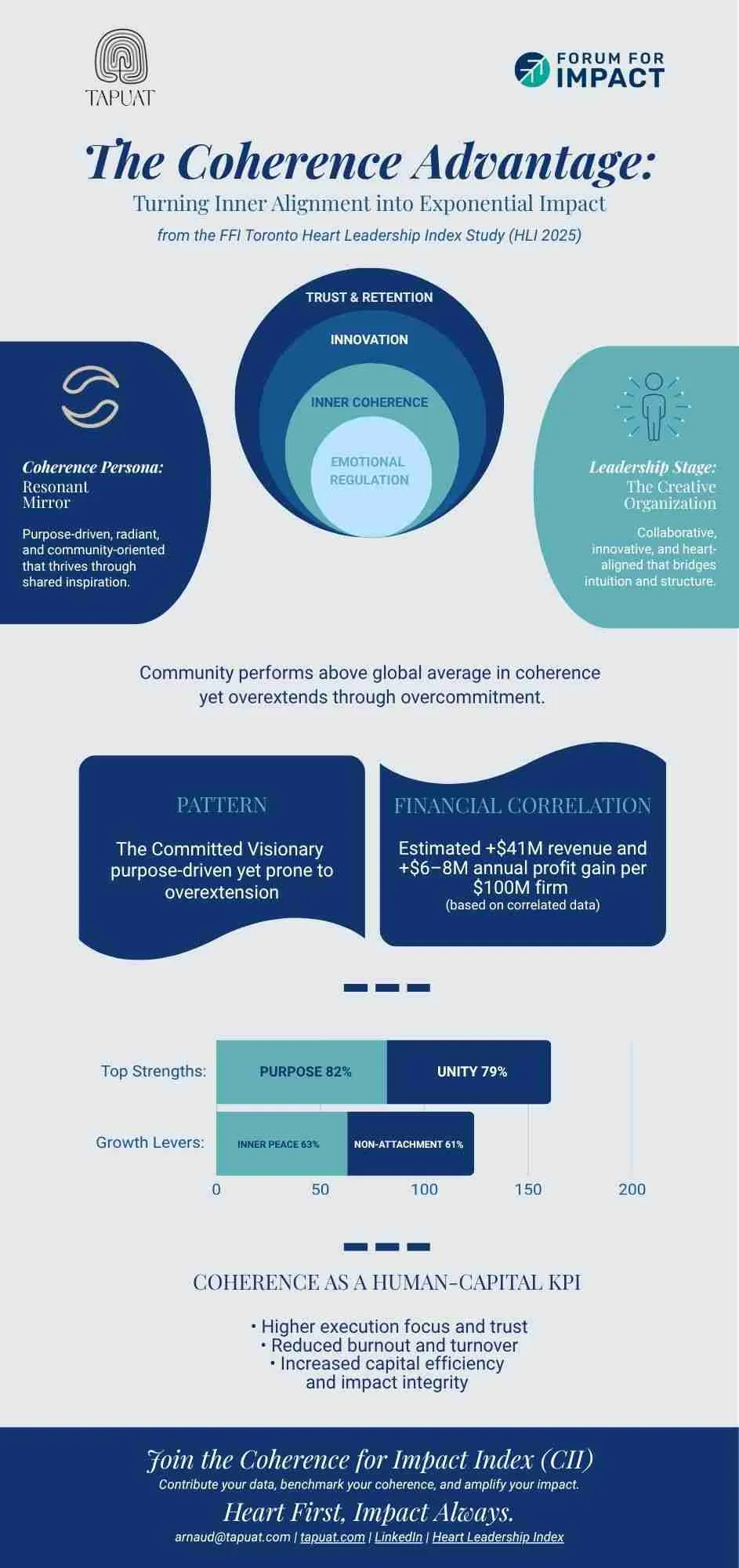
Summary — The Coherence Advantage: FFI Toronto Heart Leadership Index Study (2025)
At the 2025 Forum For Impact Global Conference in Toronto, Tapuat conducted a live Heart Leadership Index (HLI) study to explore how inner coherence relates to leadership effectiveness and organizational performance.
Participants — primarily family business leaders, advisors, and investors — completed the HLI assessment, which measures seven dimensions of Heart Leadership: Presence, Inner Peace, Inner Joy, Non-Attachment, Selflessness, Purpose, and Unity.
Key insights revealed:
-
Higher coherence was accompanied by higher self-reported trust, clarity, innovation, and adaptability.
-
Leaders with greater inner peace and presence reported stronger team cohesion and decision-making confidence.
-
The data suggests that inner alignment and outer success move together in these responses — establishing which comes first would require measuring outcomes separately, and at a later point in time.
-
Early patterns show coherence to be associated with self-reported well-being and resilience. Whether it predicts either remains an open question, and answering it would require longitudinal data.
The study describes how coherence — individually and collectively — accompanies leaders’ own reports of purpose, performance, trust, and innovation. Whether cultivating it produces those outcomes is the question this programme is designed to test next.
How to read these results
Every measure in this study, including both coherence and the qualities it is compared against, was self-reported by the same person on the same occasion. These findings therefore describe how these qualities travel together in leaders’ own accounts of their work. They do not establish that coherence produces trust, cohesion, or performance, and they cannot show which came first. Attendance at the conference was self-selected, so this group is not a representative sample of leaders.
The natural next step is to measure outcomes separately from the leader and at a later point: team-reported cohesion rather than self-reported, and business indicators collected months after the assessment rather than alongside it. A separate psychometric validation of the Heart Leadership Index, conducted on 693 leaders, reports the instrument’s reliability, structure, and stability along with its limitations.
What the reading shows
The HLI reads seven dimensions of leadership: Presence, Inner Peace, Inner Joy, Non-Attachment, Selflessness, Purpose, and Unity. In this group, Purpose and Unity scored highest. Leaders felt clear about why their work matters and connected to the people they serve. Inner Peace and Non-Attachment scored lower, a sign of leaders who hold direction well and hold pressure less easily.
The HLI is a self-report questionnaire. It asks each leader about their own experience and returns a score across the seven dimensions. This shows how these qualities appear together in a leader’s own account. It does not tell us which one causes another, and it reflects one moment in time.
The next step is to measure outcomes separately: cohesion reported by teams, and business results gathered months later. This reading is the baseline. What follows will test whether coherence, practiced on purpose, moves the results leaders care about.
Available Today: