


A Governance Insight Paper
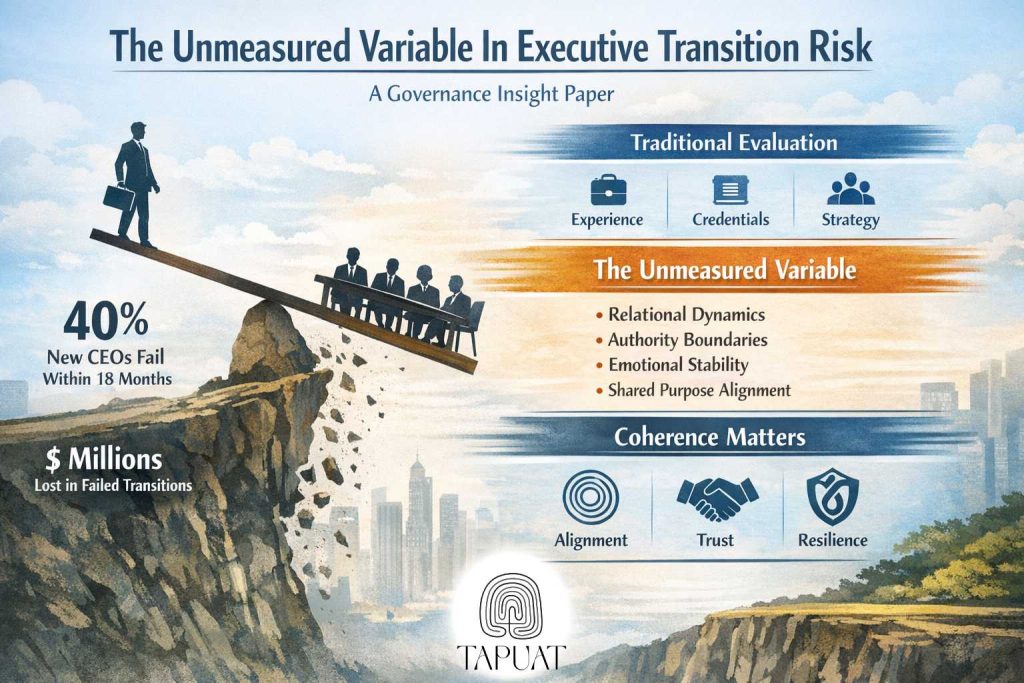
I. Executive Transition Risk Is Well Documented
Executive turnover is accelerating. In 2025, Russell Reynolds Associates reported 234 CEO departures across major global indices, with average tenure falling to 7.1 years, down from 8.3 years in 2021. In the United States, Challenger, Gray & Christmas tracked over 2,000 CEO exits in 2025, with public company CEO departures reaching an all-time record of 446. The government and nonprofit sector led all industries in leadership exits.
The velocity of turnover tells only part of the story. The failure rate during transitions reveals a deeper structural problem. Research from McKinsey and the Center for Creative Leadership estimates that 40% of new CEOs are considered failing within their first 18 months. Harvard Business Review places that figure between 35 and 40%. A study by the Institute of Executive Development found that 30% of externally hired executives leave within two years, while 23% of internal transfers follow the same pattern. Russell Reynolds Associates found that 13.1% of new S&P 500 CEOs departed within three years, with more than half of those departures occurring before the two-year mark. For external hires, the three-year departure rate rose to 17.2%.
The financial cost is substantial. Estimates place the cost of a failed executive transition at ten times the executive’s annual salary. Beyond direct expense, failed transitions erode organizational momentum, destabilize senior teams, and fracture stakeholder confidence. The Conference Board and Egon Zehnder found that in 2025, boards were executing transitions even at high-performing companies, with CEO succession rates at top-quartile firms reaching 12%, nearly matching the 14% rate at bottom-quartile firms.
One finding appears consistently across the research: the quality of the board-CEO relationship is among the strongest predictors of transition success. A Bridgespan Group survey of 214 nonprofit CEOs found that 46% reported receiving little or meaningful support from their boards upon taking the role. 39% reported that their boards were ineffective in helping set priorities during the first year. BoardSource has noted that succession planning and CEO development consistently rank as the top governance concerns across the sector.
The pattern is clear. Organizations invest heavily in executive search. They apply structured onboarding protocols. They evaluate competence, credentials, and strategic vision. Yet between one-third and one-half of transitions still result in failure or early departure. Something in the evaluation process remains incomplete.
II. The Blind Spot in Governance Evaluation
Standard governance evaluation is thorough in certain dimensions. Boards assess professional experience, functional competence, strategic orientation, and cultural fit. Executive search firms apply rigorous screening across leadership history, sector expertise, and stakeholder management capacity. These dimensions are well established and widely practiced.
Yet a distinct category of variables remains outside the standard evaluation framework. Boards rarely assess relational stability under sustained pressure. They rarely measure how a candidate holds authority boundaries when governance dynamics become contested. They typically omit any structured evaluation of ego attachment patterns, which determine how a leader responds to disagreement, correction, or loss of control. Decision tempo compatibility, the pace at which a leader processes complexity and moves toward action, is seldom mapped against the board’s own operating rhythm. And purpose integration depth, the degree to which a leader’s sense of mission is structurally embedded rather than rhetorically performed, is almost entirely absent from transition assessments.
These variables share a common characteristic: they are relational, structural, and dynamic. They emerge in the space between the executive and the governance body, and they become visible only under real operating conditions. They are also the variables most consistently cited in post-failure analyses. When boards and governance consultants review transitions that broke down, the language shifts away from competence and toward relational descriptors: misalignment, tension, loss of trust, communication breakdown, conflicting priorities.
This suggests the presence of an unmeasured variable, one that operates beneath the competence layer and determines whether the structural relationship between a board and its chief executive can hold under pressure.
III. Naming the Variable: Coherence
In governance terms, coherence is the degree of structural alignment between centers of authority within an organization. It is the capacity of a leadership system to operate as an integrated whole, particularly when facing complexity, disagreement, or crisis.
Coherence is distinct from agreement. Two parties can disagree substantively while maintaining high coherence, if their relational infrastructure supports direct exchange, mutual respect for authority boundaries, and a shared orientation toward purpose. Conversely, two parties can agree on strategy while operating in deep incoherence, marked by unspoken tensions, defensive posturing, and fragmented decision-making.
An operational governance definition of coherence includes five dimensions. First, system alignment: the degree to which decision-making authority, information flow, and accountability structures function as one integrated system rather than competing centers of control. Second, integrated authority structure: the clarity and mutual recognition of where board authority ends and executive authority begins, held with flexibility rather than rigidity. Third, emotional regulation capacity: the ability of leadership actors to remain present, responsive, and engaged during high-stakes interactions rather than defaulting to reactive or protective behaviors. Fourth, shared narrative of purpose: the degree to which board and executive leadership hold a common understanding of organizational mission that extends beyond strategic language into lived commitment. Fifth, the capacity for direct, constructive disagreement: the ability to surface tension, challenge assumptions, and hold competing perspectives without the system fragmenting or retreating into defensive postures.
When coherence is present, governance operates fluidly. Decisions integrate multiple perspectives. Conflict becomes generative. The board-CEO relationship functions as a stabilizing force during periods of uncertainty.
When coherence is absent, specific patterns emerge. Recurring micro-conflicts appear around authority, process, and communication, often repeating the same underlying dynamic in different forms. Decision gridlock develops, where boards and executives cycle through the same issues without resolution. Defensive board dynamics surface, including side conversations, voting blocs, and passive resistance. Executive isolation increases, as the CEO withdraws from genuine engagement with the board and begins operating unilaterally. Strategy drift follows, where stated priorities and actual resource allocation diverge over time.
These patterns are widely recognized by experienced governance practitioners. They are typically attributed to personality, communication style, or cultural mismatch. Coherence provides a structural frame for understanding them.
IV. Evidence That Coherence Is Measurable
The proposition that coherence can be assessed, rather than merely intuited, requires empirical grounding.
The 2025 FFI Toronto Community Coherence & Impact Study, conducted using Tapuat’s Heart Leadership Index (HLI), provides structured evidence that coherence operates as a measurable human capital variable with predictive relevance. The study assessed 110 impact investors and changemakers across seven dimensions of leadership coherence, employing normalized percentage scoring, dispersion analysis as a proxy for cultural consistency, role-based deltas, and comparative benchmarking against a global reference dataset (n = 514). The methodology produced individual and cohort-level profiles using the same structural approach applicable to board and executive assessment.
The results revealed patterned coherence distributions rather than random variation. Purpose (82%) and Unity (79%) emerged as the cohort’s strongest dimensions, while Inner Peace (63%) and Non-Attachment (61%) represented structural growth gaps. When benchmarked against the Tapuat Global Coherence Dataset, the cohort scored +12% in Purpose and +8% in Unity, alongside a -10% delta in Non-Attachment. The profile indicated strong directional clarity combined with vulnerability to overextension under pressure, a pattern that corresponds directly to measurable risk indicators around emotional regulation, decision volatility, and stress resilience.
Financial modeling within the study quantified the material implications of coherence variance. Tapuat’s analysis estimated that low coherence costs organizations approximately 7% of annual revenue through decision drag, attrition, and burnout, equivalent to $7 million annually in a $100 million organization. Under modeled scenarios tracking coherence improvement over five years, the differential between baseline coherence and resonant coherence reached $41.2 million in cumulative value, illustrating how incremental alignment gains compound into material financial outcomes.
While these findings were derived within an investor community context, the structural implication extends to governance. Coherence demonstrates three properties essential for board-level relevance. First, it produces differentiated, replicable profiles across populations. Second, it correlates with identifiable resilience and performance patterns. Third, it can be tracked longitudinally using percentage-based deltas and dispersion measures.
The significance for boards is direct. Coherence behaves as a measurable structural property of leadership systems. It can be expressed numerically. It can be compared across cohorts. It can be monitored over time. And it correlates with financial and operational outcomes. Once a variable meets those criteria, it qualifies as a legitimate governance input.
The remaining question is whether boards will choose to measure it before executive transitions, or continue diagnosing it retrospectively, after failure.
V. Board-CEO Coherence Misalignment as Predictive Risk
If coherence affects collective leadership performance, then misalignment between the coherence profile of a board and the coherence profile of a CEO represents a structural governance risk.
This misalignment takes specific, recognizable forms.
Consider a CEO with a high transformation orientation, someone whose coherence profile is organized around catalyzing change, challenging established patterns, and accelerating evolution. Place that leader within a board whose collective coherence is organized around institutional preservation, legacy continuity, and risk mitigation. The friction will emerge around pace, scope, and authority. The CEO will experience the board as resistant. The board will experience the CEO as reckless. Both are operating from coherent internal frameworks. The instability comes from the gap between them.
Consider the reverse pattern. A board that has reached internal consensus on the urgency of organizational change hires a CEO whose coherence profile favors deep reflection, relational building, and measured implementation. The board will experience impatience. The CEO will experience pressure that compromises their capacity to lead effectively. The mismatch centers on decision tempo, and both parties will interpret the friction as a failure in the other rather than a structural gap.
A third pattern: a board with fragmented internal coherence, where individual members hold competing visions, unresolved authority dynamics, and low trust among themselves, hires a purpose-driven CEO with strong integration capacity. The CEO enters expecting a unified governance partner and instead encounters a system that generates contradictory signals. The CEO’s coherence becomes absorbed by the board’s incoherence. High-capacity leaders often leave these situations within 18 months, their departure attributed to poor fit when the actual cause was structural misalignment.
These patterns are predictable. They follow from the coherence profiles of the parties involved. And critically, they are identifiable before the appointment is made.
VI. From Intuition to Measurement
If coherence misalignment predicts transition risk, then coherence should be measured before and during the transition process.
This requires a structured approach with five components. First, an individual coherence profile for each finalist candidate, assessing their orientation across the core dimensions of coherence: how they hold authority, process complexity, regulate under pressure, integrate purpose, and engage disagreement. Second, a board aggregate coherence profile that maps the collective patterns of the governance body, identifying where the board is aligned, where it is fragmented, and where its default responses under pressure are likely to surface. Third, compatibility mapping that places the candidate profile alongside the board profile to identify areas of natural alignment and areas of structural tension. Fourth, friction forecasting that names the specific dynamics likely to emerge based on the gap analysis, allowing boards and incoming executives to prepare rather than react. Fifth, a six-month reassessment that evaluates how coherence alignment has evolved under real operating conditions and recalibrates the development plan accordingly.
This framework moves governance evaluation beyond competence and cultural fit into the relational infrastructure that determines whether the board-CEO system can hold.
The Heart Leadership Index (HLI) is currently the only structured assessment framework designed to measure coherence at this level. Developed through years of research into the relationship between leader consciousness and organizational impact, the HLI provides individual and collective coherence profiles, maps alignment gaps, and generates actionable intelligence for governance decision-making. It translates the coherence construct into a practical governance tool.
VII. Governance Maturity: The Next Evolution
Governance practice has evolved in clear stages. Boards developed financial oversight systems to ensure fiduciary accountability. They built compliance frameworks to manage regulatory risk. They adopted strategic planning processes to guide long-term direction. Each of these advances represented a governance maturity leap, a recognition that a previously informal or intuitive dimension of organizational leadership required structured attention.
Coherence intelligence follows this same pattern. The relational and structural dynamics between boards and executives have always influenced organizational outcomes. They have been felt, discussed informally, and occasionally addressed through coaching or facilitated retreats. What has been missing is a structured framework for assessing, quantifying, and integrating coherence into the governance process.
Organizations that measure alignment proactively reduce transition instability. They make better hiring decisions because they understand the full picture of compatibility. They onboard more effectively because they can name the friction points before they become crises. They retain leaders longer because the relational infrastructure supports sustained performance rather than slow erosion.
The executive transition challenge will continue to intensify. Boards face shorter tenures, higher stakeholder scrutiny, and faster cycles of strategic change. The organizations best positioned to navigate this environment will be those that treat coherence as what it is: a governance variable that can be measured, managed, and developed.
The question for boards is straightforward. Every other material risk factor in governance has a corresponding measurement system. Coherence, the variable most consistently present in transition failures and most predictive of transition success, still operates outside the framework.
That is the blind spot. And it is addressable.